How to Get the Curved Sofa Trend for Less
Staff Writer
You do not need a curved sofa to have a curved living room, and if the sofa you own is still comfortable, buying a new one is the expensive way to get the look. This page is for renters and homeowners who keep saving rooms full of rounded chairs, arched lamps and soft-edged tables, and who want that in their own living room on a real budget, around a straight sofa that isn't going anywhere.
The mistake most people make is assuming the sofa is the trend. It is the most photographed piece, so it looks that way. But what makes a room read as curved is the outline your eye traces across the whole seating group: a round table in front of the sofa, a barrel chair beside it, an arc of light above, a mirror with no corners. Get three or four of those right and a boxy sofa stops looking dated and starts looking like the deliberate straight line that makes the curves stand out.
The trend is real, and it is current. In a syndicated Design Recipes column that ran on September 26, 2026, designer Cathy Hobbs put it flatly: "Curved sofas and sofas in organic shapes are on trend." She credits those shapes with making a room feel open and airy.
The forecasts point the same way, though less directly than the headlines suggest. Pinterest's 2026 Predicts release names 21 trends and describes one of them, FunHaus, as "bold stripes, sculptural silhouettes and just a wink of clownish charm." The phrase "curved furniture" doesn't appear in the release text itself. It shows up on Pinterest's individual trend pages, where, according to a January 18, 2026 breakdown by Mala Art Co., the Glamoratti trend calls for "low lighting, curved furniture, marble tables, eclectic wall art and crystal accents," and Neo Deco "blends clean lines, subtle curves and a slightly surreal, futuristic influence." So curves run through several of the year's named trends rather than standing as one of their own, and Pinterest hasn't published a search-growth figure for curved furniture specifically. Anyone quoting one is quoting something else.
That Neo Deco line is the most useful sentence in the whole forecast for someone with a straight sofa. Clean lines, subtle curves. The look is a contrast, not a full conversion.
"Curved" has become a product-listing word, and it gets attached to pieces that are really rectangles with softened corners. The test is the silhouette: stand at the doorway and look at the piece's outline against the wall behind it. A barrel-back chair, a round or oval table, an arc lamp and a circular mirror all draw a curve you can see from across the room. A square table with rounded edges, or a boxy chair with slightly bowed arms, doesn't. It may be lovely, but it won't change how the room reads.
OROA, a furniture seller, defines organic-shape furniture as "shapes that suggest living or natural forms", and that's a fair working definition. If you can't see the shape from six feet away, you're paying for the word.
The best argument against this whole approach comes from Hobbs herself. She advises choosing the sofa first and treating it as the room's anchor, because everything else follows from it. That's sound design advice, and if your sofa is worn out or you're furnishing an empty room, you should take it.
But it's advice about where to start, not a reason to throw out a working sofa. And the cheaper curved sofas carry real risks. DecorQuarter's dupe guide labels budget sofas the "highest risk" dupe category, and a review of one viral cloud-couch dupe noted that similar Amazon sofas had received Fakespot adjusted ratings as low as 1.7 out of 5. Small accent pieces fail cheaply. A sofa fails expensively and then has to be moved.
Here are the three routes side by side.
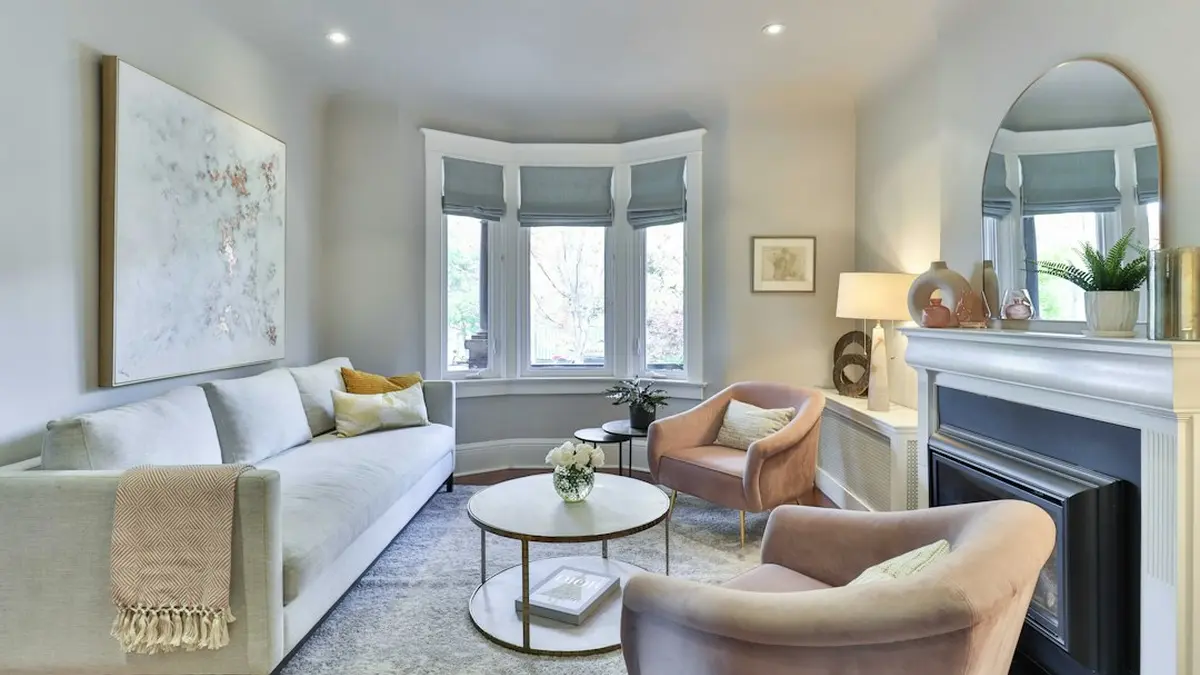
| Buy a designer curved sofa | Buy a budget curved sofa | Keep the sofa, add curves around it | |
|---|---|---|---|
| Price (Dupe.com, The Inventory, Apartment Therapy; 2026 listings) | RH Cloud Couch from about $4,685; traditional curved sofas generally start around $1,500 and often pass $3,000 | Wayfair Bula 50" loveseat $290 (down from $549); 91" boneless curved sofa $559.99 | About $568 to $968 for a chair, coffee table, mirror and lamp, using the dupe price ranges below |
| Durability (The Inventory; DecorQuarter) | Hardwood frames and premium upholstery | Sofa dupes flagged as highest-risk category; one boneless model is not recommended for anyone wanting 10+ years of use | Mirrors and lamps are low-risk dupe categories; chair quality varies and needs checking |
| Fit in a small room (Apartment Therapy; Mathis Home; OROA) | Crescent sectionals run 110+ inches wide | Rounded loveseats 58 to 70 inches; 50 to 52 inches ideal for very small studios | One accent chair around 33" wide by 33" deep, plus pieces you already have room for |
| When you move out | One large piece to move or sell | Same, and cheap foam sofas are hard to resell | Floor-standing and plug-in pieces that all leave with you; nothing attached to the walls or wiring |
| What you give up | Most of the budget | Comfort risk: one boneless model isn't recommended for people over 6 feet tall | The single big curved shape in the middle of the room |
The order matters. OROA's advice is to "start with the largest curved item your room needs: a sofa, coffee table or accent chair," and since you're keeping the sofa, that means the chair or the table comes first. The smaller pieces then repeat the shape at different heights so the eye keeps finding a curve. Swyft Home's lifestyle blog describes the same path in reverse order of cost: accessories first, accent furniture next, and a full curved sofa only once you're sure, which it frames as a way for renters to "test the trend affordably." Either way, nothing on this list needs a drill, a landlord's permission or an electrician.
You'll need the length of the wall the sofa sits on and the open floor in front of it.
The rug and coffee table are sized off the sofa, not the room.
This is the view you're designing for, and it shows which corners already look heavy.
A round side table, a globe lamp or a bowl-shaped planter you own counts. Don't buy what you have.
Upholstered pieces and large mirrors are the ones most likely to look different in person.
Set it before the chair, because the chair is where budgets run over.
This is the piece that does the most work. A barrel back or a swivel chair in bouclé or velvet gives you a full curved outline at seat height, right next to the straight line of your sofa. Angle it slightly toward the sofa so the two read as one conversation group.
The viral versions, CB2's Gwyneth and Pottery Barn's Balboa, ran about $1,500 to $1,600 in Dupe.com's 2026 roundup, with dupes from $69 to $600 and most between $130 and $310. Walmart's Beautiful by Drew bouclé swivel chair, at $298, is the one that roundup singles out. For a compact footprint, OROA's Kirby curved-back chair measures 33" wide by 33" deep by 30" high, which is a useful benchmark for a small living room.
You'll know it worked when the chair's outline is the first thing you notice from the doorway and the sofa looks like its backdrop rather than its rival.
A rectangular coffee table in front of a straight sofa doubles the straight lines at the exact point everyone looks. A round or oval top breaks them. Mathis Home's styling advice pairs curved seating with round coffee tables, and in a small room it suggests transparent pieces like acrylic or glass to cut the visual weight.
The sculptural benchmark is the Noguchi coffee table, which Dupe.com listed at $2,695 from Herman Miller, with look-alikes from $150 to $400. If you go for one, check the listed product weight and read reviews for "flimsy" or "peeling": DecorQuarter notes that solid materials stay cool to the touch and printed-film finishes flake at the corners.
You'll know it worked when you can walk around the table without thinking about its corners.
This is the cheapest strong curve you can add, and it lifts the shape up to eye level. DecorQuarter puts oversized round or organic-edge mirror dupes at $40 to $120 against $300+ for boutique originals. Mathis Home recommends placing a mirror opposite the sofa so it doubles the light and the sense of space.
For renters, a full-length arched mirror leaned against the wall needs no holes at all. The Koonmi Vintage Curved Full-Length Mirror is one listed in a 2026 dupe list on Benable. If you'd rather hang a round one, a single hook is a small, patchable hole, but check your lease first.
You'll know it worked when the mirror reflects the chair or the lamp, so the curve appears twice.
Lighting is where the forecasts lean hardest. Room Revival Studio's reading of Pinterest's 2026 trends describes FunHaus as including sculptural lighting that works as visual art. An arc floor lamp draws a curve over the sofa without touching the ceiling, which matters if you rent: it plugs into the wall, so there's no fixture to swap and nothing to put back when you leave.
DecorQuarter puts arc floor lamp dupes at $80 to $150 against $600 to $1,000 originals. For a smaller curve on a side table, Dupe.com lists mushroom lamp dupes from $7 to $50. If you want a lamp with weight and stone texture, the same logic applies to travertine table lamps, where a rounded base does the curving for you. Use warm 2700K bulbs, which DecorQuarter names as one of the cheap upgrades that make budget pieces look more expensive.
You'll know it worked when the light at night pools in a rounded shape over the seating group instead of flattening the room from overhead.
This is the step that ties the old sofa to the new pieces. Bouclé is on Benable's 2026 list of aesthetic priorities, and the Opera trend, per Mala Art Co.'s reading of Pinterest's forecast, leans on "luxurious, tactile and weighty" materials like velvet and heavy linen. Round or bolster-shaped pillows add a curve; square ones in a curvy texture still soften the sofa's edge.
None of the sources price pillows, so set your own ceiling. Two or three is plenty: the goal is to echo the chair's fabric, not to bury the sofa.
You'll know it worked when the sofa and the chair look like they were bought for the same room.
A rug that only fits under the coffee table makes each curved piece look like it's floating on its own. Mathis Home recommends a rug of at least 8 by 10 feet to anchor a curved seating area, large enough that the front legs of the sofa and the chair both rest on it.
Budget polypropylene rugs run $60 to $200, per DecorQuarter, against $800+ for wool. The trade-off is that they mat within 12 to 18 months in high-traffic areas, so put the cheap one where people sit, not where they walk through.
You'll know it worked when the sofa, chair and table look like one island instead of three separate purchases.
Choose one compact curved piece, such as a rounded chair or petite sofa, and keep the rest of the room simple.
Curving everything. The pull, once the chair arrives, is to keep going: round side tables, round tray, round art, scalloped shelves. Pinterest's own FunHaus guidance warns against this, telling readers to "pair punch-line patterns with pared-back palettes so the space feels elevated". Mathis Home says the same about furniture: keep the surrounding pieces low-profile and layer textures rather than competing patterns. You'll recognize the problem when the room looks busy but no single piece stands out. Take one curved thing away, and keep the straight sofa as the calm line the rest plays against.
A chair that's too big for the room. Curved pieces take up their full width and depth even where the curve leaves empty space behind them. In a 240-square-foot studio featured by Apartment Therapy, resident Austin Larkin found most sofas on the market simply too large, and finding one around 60 inches was, in his words, "not easy to do." The same arithmetic applies to chairs. If you can't walk past it without turning sideways, it's too big. Measure before you buy, and use OROA's 33-by-33-inch chair as your yardstick.
Trusting the star rating. The cloud-couch review noted that adjusted ratings for similar products dropped as low as 1.7 out of 5, and that the brand behind the listing wasn't disclosed. If you can't find who makes it, you can't check whether earlier buyers regretted it. Read the low reviews first and search them for "flimsy," "peeling" and "seams," which are the words DecorQuarter says give a cheap piece away.
Foam that sags. This mostly applies if you do end up buying an upholstered curved piece. DecorQuarter's threshold is specific: foam density below 1.2 pounds per cubic foot sags within months, and 1.8 pounds or more holds its shape longer. If the listing doesn't give a density, ask, and treat a non-answer as an answer.
Judging a compressed sofa on day one. Boneless, foam-based sofas often ship compressed. The 91-inch model reviewed by The Inventory needs about 72 hours to reach its full shape and firmness, so don't decide it's lumpy or too low until three days have passed. Do make sure that's still inside the return window.
A rug that's too small. A small rug under a round table looks like a placemat. If the rug doesn't reach the front legs of the seating, it's working against the curves rather than collecting them. Go to 8 by 10 feet, or larger if the room allows.
Your room is under about 250 square feet. In a studio, the accent chair may be one piece too many. Here the rounded loveseat becomes the better buy, because it replaces seating rather than adding to it. Apartment Therapy's guidance for very small spaces is a curved, kidney-shaped silhouette, ideally 50 to 52 inches wide and under 60. At the bottom of the price range, the Wayfair Bula 50" loveseat was listed at $290, down from $549, with 175 five-star ratings at the time. If the room is that small, swap the arc lamp for a table lamp and let the mirror carry the curve.
Your sofa is genuinely done. If the cushions have given out or the frame wobbles, you're buying a sofa anyway, and the case for a curved one is strong: Hobbs's advice to start with the sofa applies in full. For apartments and bedrooms, Mathis Home's rounded loveseat category runs 58 to 70 inches, and its small-space advice is a compact loveseat or a 72-inch curved model in light, neutral upholstery. Spend on the frame and the foam, because that's where cheap curved sofas fall short.
You're over 6 feet tall, or you want something that lasts a decade. The boneless 91-inch sofa at $559.99 is explicitly not recommended for either group, because of its low back support and its lifespan. Its reviewer positions it for renters, first-time homeowners and trend-chasers, which is honest. If that's not you, the accent-piece route is a better use of the same money.
You have a big open-plan room. Small curved accents can get lost in a large space. Hobbs recommends floating sectionals in bigger rooms rather than pushing them against walls, and Mathis Home notes that full crescent sectionals are built for large open-concept rooms at 110 inches or more. If you're keeping a straight sofa in a big room, pull it off the wall, put the rug and round table in front of it, and add two curved chairs facing it instead of one. That builds a rounded conversation group in the middle of the floor.
You rent and the lease is strict. Everything in the steps above stands on the floor or plugs into an outlet, which is the point. The one move to check is hanging a mirror. If even a single hook is off-limits, buy the full-length arched mirror and lean it.
A hypothetical living room with a straight sofa that stays. Prices are the 2026 ranges from Dupe.com and DecorQuarter above; the chair is priced at the one fixed figure the sources give.
| Bouclé swivel chair (Beautiful by Drew) | $298 |
|---|---|
| Round coffee table dupe | $150 to $400 |
| Round or arched mirror | $40 to $120 |
| Arc floor lamp | $80 to $150 |
| Total, four pieces | $568 to $968 |
| Optional: polypropylene rug, 8 by 10 | $60 to $200 |
| Total with rug | $628 to $1,168 |
Four curved pieces come to $568 to $968, which is less than a single viral bouclé chair at $1,500 to $1,600 and roughly a fifth of the RH Cloud Couch's $4,685 starting price. Even with the rug, the whole room costs less than a typical entry-level curved sofa at $1,500, and every piece moves with you.
Prices like these move with every sale, so treat them as what they were when the sources published in 2026, not what you'll find at checkout. OROA, for one, was running a warehouse sale of up to 60% off when it wrote about the trend.
What the figures don't show is where the money is safest. DecorQuarter puts mirror, lamp and art dupes at 80 to 90% savings and calls them low risk, because a mirror is a mirror whatever it cost. It puts sofa dupes at 60 to 75% savings and calls them the riskiest category. That's the real argument for this approach: you spend the least where quality matters most, and you put your money into the pieces that are hard to get wrong. DecorQuarter also estimates that around $60 of warm bulbs, natural-fiber throws and brass hardware can make $250 of dupes look like a $1,000 room. That's a claim from a dupe site, so weigh it accordingly, but the direction is right: styling does more than price.
Comments
No comments yet. Be the first to comment!
Leave a Comment