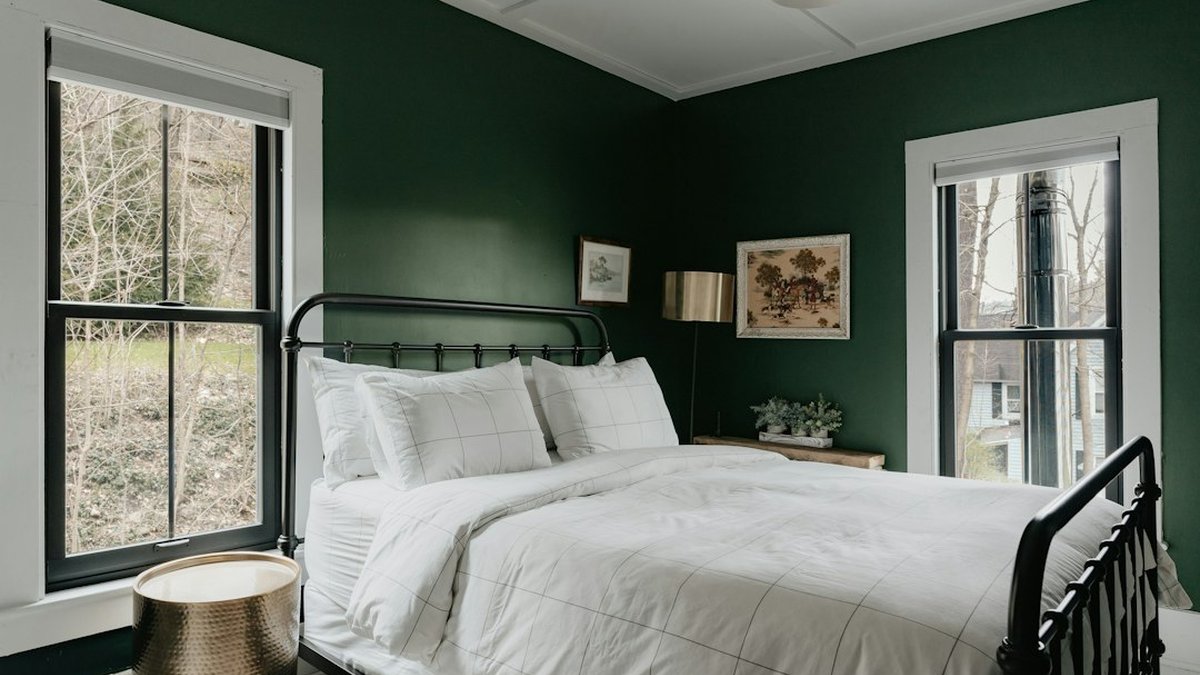
Decorate a Bedroom With 2027's Color of the Year
Staff Writer
Two paint companies have just told you to put green in your bedroom. Behr named Grounded T27-01, an earthy olive with subtle brown undertones, its 2027 Color of the Year on August 26, 2026. Sherwin-Williams followed on September 15 with Celery SW 6421, which it calls "an airy, herbal green." This page is for anyone who wants that green in a bedroom this fall without assuming they can paint: renters working around a lease, owners who aren't ready to commit a wall, and anyone doing it on a real budget.
Most people get one thing wrong with a Color of the Year. They treat it as an object. They buy one green throw, lay it on a gray duvet, and the room looks like it has a green throw in it. Neither brand released its green alone. Each came with a coordinating palette, and that palette is the part that turns a trend color into a room.
The two picks are both green, but they are not the same green, and the difference matters in a bedroom.
Celery SW 6421 is pale and light. Sherwin-Williams describes it as a soft, muted green with subtle yellow undertones. Apartment Therapy calls it softer and more muted than a true chartreuse, though it keeps that color's warmth. The brand's color marketing manager, Ashley Banbury, put it this way in the joint press release: "It's a soft, fresh yellow-green with subtle warmth, so it feels uplifting without becoming overly bright or saturated." If you have seen it described as cool, the brand and every source here disagree. The yellow is what keeps it from reading clinical, according to Homes and Gardens.
Grounded T27-01 is deeper and earthier. Behr places it between olive and moss, with brown underneath. Behr's Head of Color, Kayla Kratz, says its "organic warmth creates a sense of calm and renewal."
So one is light and a little yellow, the other darker and a little brown. Homes and Gardens reads Celery as a move away from the deep, moody sages and olives of recent years. Grounded sits much closer to that moody end. My view is that for most bedrooms Celery is the easier pick, because Sherwin-Williams lists bedrooms among its recommended rooms and Porch Daydreamer found it soft enough to work as a whole-room neutral. Grounded is the better pick if your room already has a lot of wood and you want depth rather than light. Behr's own headline uses are living rooms, kitchens and exteriors, though its related materials do position the color for bedrooms and personal retreats.
Why the palette matters. Sherwin-Williams put Celery in a nine-color coordinating palette called Curated Harmony: Potentially Purple SW 6821, Artichoke SW 6179, Cocoon SW 6173, Kirsch Red SW 6313, Cosmos SW 6528, Georgian Bay SW 6509, Plum Brown SW 6272, White Flour SW 7102 and Woven Wicker SW 9104. Behr paired Grounded with seven legacy colors: Coastal Beige, Wheat Grass, Environmental, Denim Light, Smokey Claret, Sarsaparilla and Mozart. Behr says its set spans warm neutrals, earthy tones, muted pinks, clay hues and airy blues.
Apartment Therapy's reading of the Sherwin-Williams release is the one to hold on to. The palette exists to make the green easier to build a full room around rather than use as an isolated accent. That's the mechanism. A green reads as intentional when the colors around it were chosen with it. For this fall, that means taking your khaki and cocoa neutrals from the palette's neutral end, not from whatever beige you already own.
There are three ways to get the green into the room. Which one you use depends on your lease more than your taste.
| Paint an accent wall | Removable wallpaper | Headboard, bedding, lamp | |
|---|---|---|---|
| Landlord sign-off (Apartment Therapy, rental painting guide) | Needed before you start | Treated as renter-safe by the sources; check your lease anyway | Not needed |
| Undoing it at move-out (Apartment Therapy) | Repaint with a high-hide primer such as KILZ 3, then the original white | Peel at a 45-degree angle, clean residue with vinegar and water | Take it with you |
| Wall condition needed (WonderHowTo) | Any wall you are allowed to paint | Smooth, with paint cured about 30 days; not heavily textured or freshly flat-finished | None |
| How much green it adds | A full wall of the exact brand color | A full wall, but in a printed color you match by eye | Patches at bed height, where you look most |
| Exact brand color available (Behr, Sherwin-Williams) | Yes: Grounded in Behr Dynasty, Marquee, Ultra and Premium Plus; Celery as SW 6421 or HGTV Home HGSW6421 | No; the sources name no wallpaper in either color | No; you match fabric and ceramics to a sample |
The fairest case for paint comes from Apartment Therapy's rental painting guide, which calls it the fastest and least expensive way to remake a rental room. That's a reasonable point. Paint is the only route that gives you the actual brand color at wall scale. But the same guide makes it conditional twice over: you need permission first, and the reversal only works if the color is fully covered before you leave. If you can meet both conditions, paint. If you can't, the textile route gets you most of the effect for none of the risk.
This takes a weekend of doing and a week or so of looking. The looking is not optional. Gather these first:
Samplize sells Grounded; Sherwin-Williams sells Celery in its own Peel & Stick format.
For example White Flour, Woven Wicker and Cocoon for Celery, or Coastal Beige and Sarsaparilla for Grounded.
Your record of the original state for move-out.
An email is enough of a record.
For wallpaper rolls or a headboard.
1. Order samples of both greens. Don't choose from a screen. Samplize makes its Grounded samples with two real coats of Behr paint, and Sherwin-Williams offers Celery in the same peel-and-stick format. You'll see the real color and sheen without opening a can. Neither source lists a price, so check at checkout. The cost in time is the delivery wait.
2. Stick them up where the bed is, and live with them. Put one sample on the wall behind the headboard and one near the window. Look at them in the morning, in the evening, and under the lamp you actually read by. Porch Daydreamer warns that pale yellow-greens can shift undertone with the surrounding finishes and light. That shift is what you're checking for. It worked if one of the two still looks like the color you wanted at every hour. It didn't if Celery goes sour yellow or Grounded goes muddy. Give it five to seven days, and don't take the samples down yet.
3. Pull your neutrals from the palette. This is the step that stops the green reading as a lone accent. Sample two or three of the palette's neutrals next to your chosen green. Choose from the brand's list rather than guessing, and let the samples tell you which reads as khaki and which as cocoa on your wall. These neutrals go on the large, quiet things: sheets, curtains, a rug. Nothing new is needed if what you own already sits comfortably beside the samples.
4. Decide what the biggest green surface will be. A painted wall, a papered wall, or the headboard. Pick one. If you're an owner, or you have written permission, the wall behind the bed is the obvious place. If you're renting without permission, the headboard becomes your wall.
5a. If you're painting, plan the exit before the entrance. Photograph the wall. Buy the exact color: Grounded is sold only through The Home Depot, in the Behr Dynasty, Marquee, Ultra and Premium Plus lines, and Celery comes as SW 6421 or as HGTV Home by Sherwin-Williams HGSW6421. Paint one wall, not the room. Before you move out, cover it with a high-hide primer; Apartment Therapy names KILZ 3 Premium Primer for concealing bold colors in fewer coats, then the original white. Paint takes a day plus drying time. The sources give no price per gallon.
5b. If you're papering, test the wall first. Removable wallpaper wants a smooth wall whose paint has cured for about 30 days, according to WonderHowTo. Heavily textured walls and freshly flat-finished walls risk the paint coming off with the paper later. Put up a small offcut somewhere hidden, leave it a few days, and peel it at a 45-degree angle. If it comes away clean, go ahead. If it takes paint with it, stop and go to the textile route.
6. Put the green at bed height, more than once. Whatever you did in step 5, the green needs to appear on at least two or three separate things near the bed. A green headboard, a green pillowcase set and a ceramic lamp. Or green bedding, a green lampshade and a small green object on the other nightstand. Hunker suggests smaller doses like these for anyone hesitant to commit a whole room. Repetition is what makes them read as a scheme. It worked if you can't point to one piece as "the green thing."
7. Add the materials the green was chosen to sit with. Sherwin-Williams says Celery pairs with natural wood tones and deeper jewel tones. Porch Daydreamer adds aged brass, aged bronze, leather and timeworn finishes. A wood tray, a brass picture light, a leather catchall: one or two of these finishes the look. This is also where a jewel tone from the palette, Kirsch Red or Potentially Purple, can go as a single small accent.
8. Take the samples down and step back. If the room reads as green, neutral and wood in roughly that order of attention, you're done.
Sherwin-Williams pairs Celery with deeper jewel tones, the same family our guide to styling a jewel-tone fall mantel works from, so a mantel or dresser top can carry the accent while the bedroom carries the green.
Read the mantel guideThe green changes color after dark. Porch Daydreamer names this as the main risk with pale yellow-greens. You'll recognize it when a wall that looked fresh at noon looks jaundiced under a warm bulb. The fix is to test at night before buying anything, per step 2. If it's already on the wall, try a different bulb in the bedside lamp before you repaint.
Celery in a dim room. Apartment Therapy says Celery performs best in rooms with ample indirect daylight. In a dark bedroom it has less light to work with, and the undertone problem above gets worse. If your bedroom faces a wall or an air shaft, Grounded's depth may suit it better, or keep Celery to textiles.
The single green object. It's easy to spot: one green thing in a room that is otherwise the same as before. The brands built palettes to prevent this. Repeat the green at least twice and change one neutral to a palette color.
Peeling the paint off with the wallpaper. WonderHowTo flags textured walls, freshly flat-finished walls and paint cured for less than about 30 days. You'll know it when the backing comes away with a skin of paint on it. Stop peeling, and use a test piece next time.
Peel-and-stick tile as a green feature wall. Apartment Therapy's rental DIY rules point out that peel-and-stick tile is heavier than most peel-and-stick materials and more likely to damage walls. If you want tile, the same piece recommends a layer of peel-and-stick contact paper underneath as a buffer.
Assuming peel-and-stick is always the easy removal. The same writer found traditional pasted wallpaper sometimes easier to remove than peel-and-stick, and took one installation down cleanly with a clothing steamer. Don't pick peel-and-stick on the assumption that it will come off more easily.
Painting and hoping. Painting without permission, or painting a bold green without planning the cover-up, is the one move on this page that can cost you your deposit. The rental painting guide is clear that reversal only works if the color is fully covered.
Owners. Everything is open to you, and the only question is which green. Porch Daydreamer found Celery soft enough to paint a whole bedroom without it feeling oversaturated. Homes and Gardens says it can work either as an accent or all over, depending on the room's light. An owner with a bright bedroom can reasonably paint all four walls.
Renters with permission. One wall, in writing, with a primer bought for move-out. Keep the photos from before.
Renters without permission. Textiles and objects only, or removable wallpaper once you've tested the wall. Most of the green sits at bed height anyway, which is where the eye lands in a bedroom.
A landlord who repainted just before you moved in. If the walls were painted recently, wait about 30 days before applying removable wallpaper. Ask when they were painted, and wait if the answer is recent.
Textured or flat-painted walls. Rule out removable wallpaper here and use the headboard as your large green surface.
Which store. Behr colors are sold only through The Home Depot. Celery is available under two codes, SW 6421 from Sherwin-Williams and HGSW6421 from HGTV Home by Sherwin-Williams, and the press release presents them as the same color across both brands.
The number you most want is the one none of these sources gives: what a gallon of Grounded or Celery costs against a roll of removable wallpaper. Neither brand's announcement, nor any of the coverage here, publishes a price, and I'm not going to invent one. Check the retailer on the day you buy.
What the sources do give are the numbers that decide how long this takes and whether it comes undone cleanly. As for worth, Behr's own research, published with the August 26 announcement, found 84% of Americans agree paint color is critical to making a space feel like home. That's a paint company's survey, and a paint company has an interest in the answer. It still points to something true. Color carries a room's character, which is why taking it from the palette beats buying one green thing.
Comments
No comments yet. Be the first to comment!
Leave a Comment